
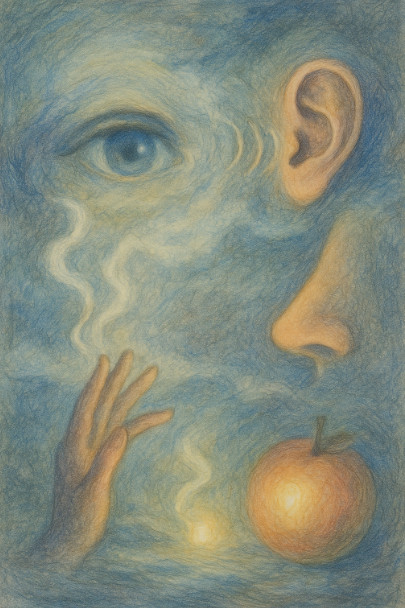
The more senses we engage in dreaming, the deeper we feel and recall them
In dreams, we are transported to richly-imagined landscapes that feel intensely real when we’re immersed in them. Yet most dream reports lack sensory detail beyond the visual. This may be because we humans tend to rely so heavily on our sense of sight. If a dog could tell us her dreams, I expect it would be a detailed olfactory journey – though a recent study found that smell is the sense least often reported by dreamers.
This makes the dream a student recently shared with me all the more striking. Cally studied Embodied Experiential Dreamwork with me over the past year. A central part of this practice is to re-enter our dreamscapes as deeply as we can, explicitly engaging all of our senses: not just sight, smell, touch, taste and sound, but also things like the emotional quality, temperature and mood of the dreamscape. Noticing and inviting sensory details in dreams appears to awaken them, enriching our dream lives.
Cally wrote: “This practice has deepened my embodied dreamwork experience and understanding… I have experienced more sensory awareness in my dreams. For instance, I dreamt of a shoe that I placed in the microwave and it came out burnt to a crisp, black and charred. I could smell the burnt stench very strongly. I am also hearing more in my dreams, bridge and fog horns while on a boat, and feeling more: things like soft flesh and cold surfaces. Maybe these sense experiences have always been there, but they are capturing my attention more and offering more insight, meaning and pathways to explore.
When I worked the dream with my dream partner, I had to put the shoe on, of course! It was still intact even though it was burnt to a crisp. It fit. I watched my body slowly become half deer starting with the foot I slipped into the shoe, which became a deer hoof (not at all what I was expecting). I felt the need to go outside to the big Hemlock tree in our front yard and lie down. I was overcome with the scent of pine needles and the great evergreen trees of the Pacific Northwest. I realized how much I was going to miss the beauty and love I have of this land when I immigrate to New Zealand. Half deer, half human, half Pacific Northwest and half South Pacific, where our oceans touch…
The dream is still is working through me. The Cinderella piece too, not the fairy tale ending, but almost its opposite. The significance of her shoe and how she is identified by how it fits. There is so much more mystery and meaning to explore for me.”
Mapping dream senses
A recent study (van der Heijden et al., 2024) explored the question: how often do our senses awaken in dreams? Instead of relying on free-flowing dream reports that risk leaving sensory detail out, the researchers gave participants a structured diary. Each morning, more than 500 people noted not just what they dreamed, but what they saw, heard, touched, smelled, or tasted in those dreamscapes. Across seven nights, nearly 3,500 dreams were gathered.
The Hierarchy of Dream Senses
Vision reigned supreme: 96% of dreamers reported visual scenes, such as faces, places, shifting landscapes. Next came sound: voices, music and other noises were present in 86% of dreamers. Touch followed was present for 62% of participants: hands brushing, textures felt, the sensation of pain or pressure. Smell and taste were rare visitors. Only 16% of dreamers reported them across the week.
Most dreams were not confined to one sense. Vision and sound often partnered, like a duet, with touch sometimes joining in. Nearly a quarter of the dreams blended sight, sound, and touch together, showing that dreams tend toward multisensory richness rather than solitary impressions. Only 2% of reports described dreams without any sensory experiences.
Emotion, Clarity, and the Senses
The more senses a dream engaged, the more vivid and emotional it became. Dreams layered with color, sound, and texture carried stronger emotional tones. Sensory richness was also linked to clarity: such dreams were remembered more sharply upon waking.
Interestingly, the emotional flavor of dreams swayed the senses. Positive dreams more often included sight, smell, and taste, while negative dreams leaned toward sound and touch. Perhaps our psyche chooses its palette depending on the mood it paints
Why This Matters
Dreams are not idle entertainments. They help consolidate memory, rehearse challenges, and process emotions. By examining their sensory architecture, we glimpse how the sleeping brain re-creates and reshapes lived experience.
The authors note the individuality of these inner worlds. Some dreamers may be more attuned to certain senses, perhaps reflecting how they engage the world while awake. Those with sensory impairments, for instance, often dream with compensatory richness in other modalities. Those with aphantasia, the inability to create mental pictures, may dream more frequently using senses other than vision.
Awakening the dream senses
To dream is to wander through a private gallery where senses blend and transform. Sometimes the dream is a silent film, sometimes a noisy concert, and more rarely, a fragrant feast. This study reveals that our nightly journeys are not only visual spectacles, but fully-embodied experiences. It also seems that we can enhance our sensory dream journeys, and thus perhaps our dream recall by bringing in more of our senses as we explore and engage with our dream lives.
Reference
van der Heijden, A. C., Thevis, J., Verhaegen, J., & Talamini, L. M. (2024). Sensational dreams: the prevalence of sensory experiences in dreaming. Brain Sciences, 14(6), 533.