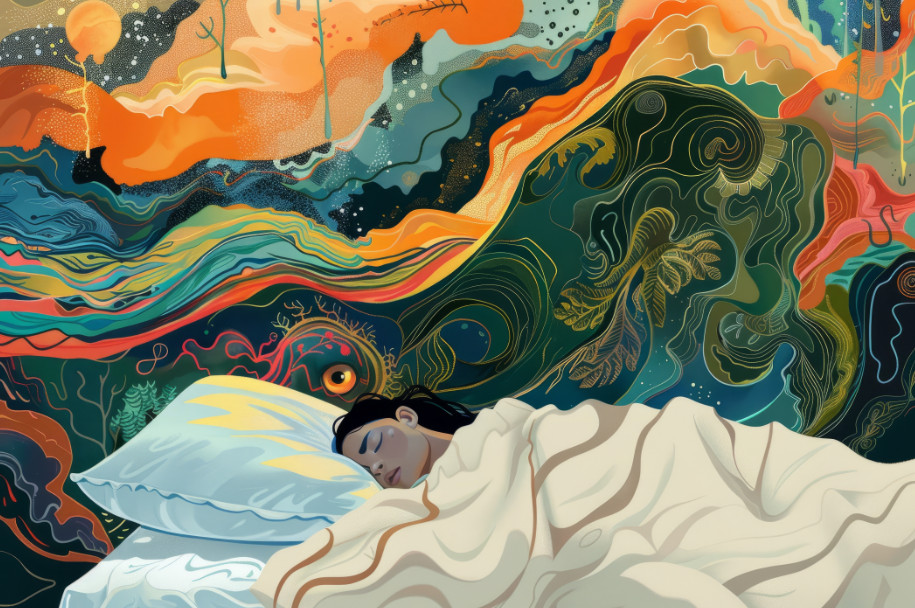
For many who have experienced trauma, the impact doesn’t end with waking. Nightmares can be a persistent, distressing echo of past events, leaving you exhausted, re-traumatized, and robbed of restful sleep. Finding effective strategies to quiet traumatic nightmares is a significant step toward reclaiming peace. Such strategies may be more accessible than you think, both for dreamers and the therapists who support them.
As someone deeply committed to helping individuals navigate the complex terrain of trauma recovery, I am always on the lookout for innovative approaches. One noteable recent study highlights the potential of lucid dream workshops for reducing PTSD symptoms and distressing nightmares (Yount et al., 2025). What I find most interesting about the study is that it supports the use of integrative, experiential approaches, though not necessarily dream lucidity, as a path to trauma recovery.
Perhaps this study points to something essential about nightmare treatment research: we haven’t been able to clearly isolate a single mechanism of action because there are many ways to help, and many combinations that are helpful. Clearly some common factors stand out.
Building on Prior Work: A Controlled Approach
The study in question advances an earlier pilot study in which 55 participants with chronic PTSD were offered a 6-day workshop by prominent lucid dreaming teacher Charlie Morley (Yount et al., 2024). Impressively, all experienced significant reductions in their PTSD symptoms. But Morley experienced real challenges validating his intervention. He describes the process in his TedX talk (https://www.youtube.com/watch?v=kuNCjUYMhTE).
One problem with the initial study, from a scientific perspective, is that it does not isolate the various interventions used over the course of the multi-day workshop, so it’s not possible to know which specific factors were responsible for the impressive results. Likely it was the combination of learnings and interventions that led to trauma recovery. Integrative approaches have gained much traction in psychotherapy despite the challenges they pose for research-based validation. Common factors, such as tangible empathic support from a therapist, and community resonance within a group, have been shown to contribute greatly to the healing process in general. In dreamwork, experiential depth appears to be a helpful common factor (Ellis, 2019).
I wrote about ‘common factors’ in my book, A Clinician’s Guide to Dream Therapy: “In the field of psychotherapy, 30 years and 60,000 studies later, it has been determined that all ‘bona fide, theory-driven’ approaches… have been shown to work equally well. Or to quote the dodo bird in Alice in Wonderland, ‘Everyone has won and all must have prizes!’ So rather than investing a lot more time and research effort pitting one modality against another, there is a progressive movement toward identifying common factors” (Ellis, 2025). These may ultimately be more important than specifics of an intervention. A case in point: although the study I am referring to documents the effects of a lucid dream workshop as a means to heal trauma nightmares, the intervention worked even though achievement of lucidity was not what actually helped!
The most recent version of Morley workshop study did correct a major flaw: a control group was added. Of the 100 participants with chronic PTSD, half were randomly assigned to a waitlist. The rest attended 22 hours of programming over six consecutive days. The workshop was designed to teach participants techniques to achieve lucid self-awareness within their dreams and to use this awareness to transform nightmares and integrate their trauma.
The findings offer hope. The workshop group showed significant reductions in overall PTSD symptoms (measured by the PCL-5) and nightmare distress, along with reported improvements in well-being and diminished negative emotions. These changes were sustained at a one-month follow-up (Yount et al., 2025).
However, no significant correlation was found between simply experiencing lucid dreams and the reduction in PTSD or nightmare symptoms. This suggests that while lucid dreaming was a core component, the workshop’s integrative approach likely played a more significant role in the observed improvements.
Beyond Lucidity: The Holistic Approach
The workshop wasn’t just about learning to have lucid dreams. Participants received education on the neuroscience of sleep and dreaming, practiced mindfulness for deep relaxation, learned sleep hygiene principles, and engaged in techniques to improve dream recall and plan for intentional dream engagement. The inclusion of a psychotherapist for individual consultations and group dream-sharing circles fostered a supportive environment for processing emotions and normalizing experiences (Yount et al., 2025).
It is plausible that this rich blend of education, self-regulation practices, and community support contributed significantly to the therapeutic outcomes. The study authors themselves highlighted that such a comprehensive approach can help address the various facets of PTSD, including emotional regulation, cognitive reframing, and the critical need for interpersonal connection in trauma recovery. In essence, it provided a structured framework for “revisiting, reprocessing, and restructuring traumatic memories in the lucid dream state” – a powerful form of experiential learning (Yount et al., 2025).
What This Means for Experiential Healing
This research offers valuable insights for those grappling with trauma-related nightmares and for practitioners exploring integrative healing modalities. It suggests that providing individuals with tools to engage actively and intentionally with their inner world, including their dreamscapes, can be a powerful complement to traditional therapies. The focus on preparation: things like mindfulness, sleep hygiene, and dream planning appears to build a foundation for deeper internal work. If such work takes place in community and with professional support, it seems more likely to succeed.
For those who may find conventional treatments challenging or prefer alternative paths, this kind of guided, experiential dreamwork, especially within a structured and supportive environment, offers a viable and empowering avenue for healing. The path toward lucid dreaming, and the deep, experiential and intentional engagement with trauma dreams, appears to be constructive and potentially healing whether you achieve lucidity or not.
References
Ellis, L. A. (2019). Common factors leading to a universal approach to dreamwork: A qualitative analysis. Dreaming (29), 1, 22-39.
Ellis, L.A. (2025). A Clinician’s Guide to Dream Therapy: Demystifying Dreamwork. New York: Routledge.
Yount, G., Stumbrys, T., Cannard, C., Delorme, A., Kriegsman, M., & Wahbeh, H. (2024). Decreased posttraumatic stress disorder symptoms following a lucid dream healing workshop. Traumatology, 30(4), 550-558.
Yount, G., Stumbrys, T., Taddeo, S., Cannard, C., Delorme, A., Kriegsman, M., & Wahbeh, H. (2025). Decreased PTSD symptoms following a lucid dreaming workshop: A randomized controlled study. European Journal of Trauma & Dissociation, 9(1), 100510. https://doi.org/10.1016/j.ejtd.2025.100510