By Dr. Leslie Ellis
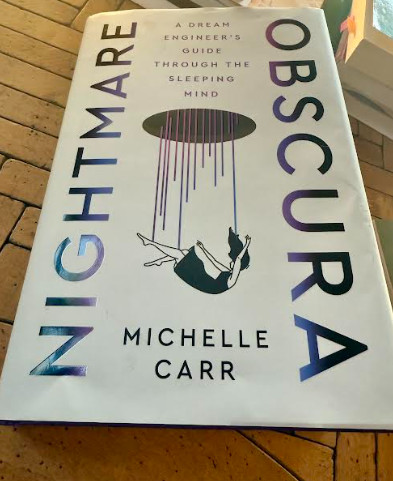
Dreams and nightmares immerse us in experiences at the edges of what we can know. To study them is to wander a landscape of the night, of half-remembered images and startling creativity. Michelle Carr has spent her career walking this terrain with unusual determination and curiosity. Nightmare Obscura: A dream engineer’s guide through the sleeping mind follows her through sleep laboratories around the world as she tries to understand how our dreams arise and whether, with intention, they might be reshaped.
‘Deftly Navigates Vast Oceans’ of Dream Science
Dream science has accelerated rapidly in the past few decades. We now know far more about how dreams are formed, what roles they may play in emotional regulation, creativity, and learning, and how they can drop into the dark territory of nightmares. We’ve learned how to quiet distressing dreams, how to cultivate lucid awareness, and how to guide dream imagery in ways that support healing. The once-opaque world of dreaming is starting to show its structure.
What is most striking about Carr’s book is not just the breadth of research she covers, but the grace with which she weaves it into a narrative. Her writing is clear and conversational, and the science feels lived… because a good portion of it is her lived experience. Many passages are marked by stints of long nights in sleep labs watching patterns of the dreaming mind reveal themselves over the arc of a career shaped by curiosity.
Carr’s work intersects with mine in the area of nightmare treatment. During her stint as a research fellow in Swansea, Wales, I visited and taught her group embodied dream therapy practices and Focusing, Eugene Gendlin’s gentle method for listening to the body. I can see how Focusing has influenced In her chapter in dreams and health, Michelle writes:
“The inner world of dream and nightmares is malleable, suggestible to the influence of waking intention, lucid dreaming, and even technologies for dream engineering…
As long as you are afraid, the nightmare will remain… we are simultaneously both producing and experiencing a dream, so the dream is reflecting back to us our feelings. Because of this conundrum, the trick to facing nightmares is to first find a way to feel calm, positive, open or curious, so that when you turn to face the nightmare, it will become easily transformed, mirroring your positive feelings back to you.”
Carr also highlights recent research into the memory sources of dreams. We tend to dream from experiences that are novel, social, embodied, and emotional, those moments that linger. She also documents the physical underpinnings of dreaming itself. It appears we dream differently in specific circumstances, such as during pregnancy, at the end of life, and when our health falters. These shifts reveal something fundamental:
“These patterns remind us that dreams have their foundations in our physical bodies and are fundamentally rooted in our physical health. It is perhaps time that a paradigm shift is called for, acknowledging that how we experience sleep is inextricably tied to our well-being, and offers a valuable source of information in all areas of medicine.”
Dreams as Messengers and Clinical Allies
This is one of the book’s quiet yet powerful invitations: to see dreams not as decorative byproducts of the mind, but as nightly messages from the intersection of psyche and soma. “Working with nightmares, rather than avoiding them, may be one of the most direct paths toward restoring healthy sleep,” Carr wrote. Paying attention to dreams can deepen clinical understanding and illuminate parts of a patient’s experience that symptoms alone never reveal.
Nightmare Obscura is ultimately a testament to curiosity, to persistence, and to the belief that even our darkest dreamscapes are worth exploring. Carr reminds us that the dreaming mind is not a sealed chamber but a responsive, living ecosystem—one that invites partnership rather than fear.
As dream engineers like Michelle begin to peer into the black box of the dreaming mind with curiosity and good intentions, they discover many ways to understand and intervene in our dreams. This is especially good news for those who struggle with nightmares: we now have multiple, effective avenues to influence and reshape our dream worlds, and the horizon is brightening still. Soon we may be able to see into a dreaming mind in real time, or even recreate immersive versions of our dreams, allowing us to re-experience them in a gentler, more luminous light.