
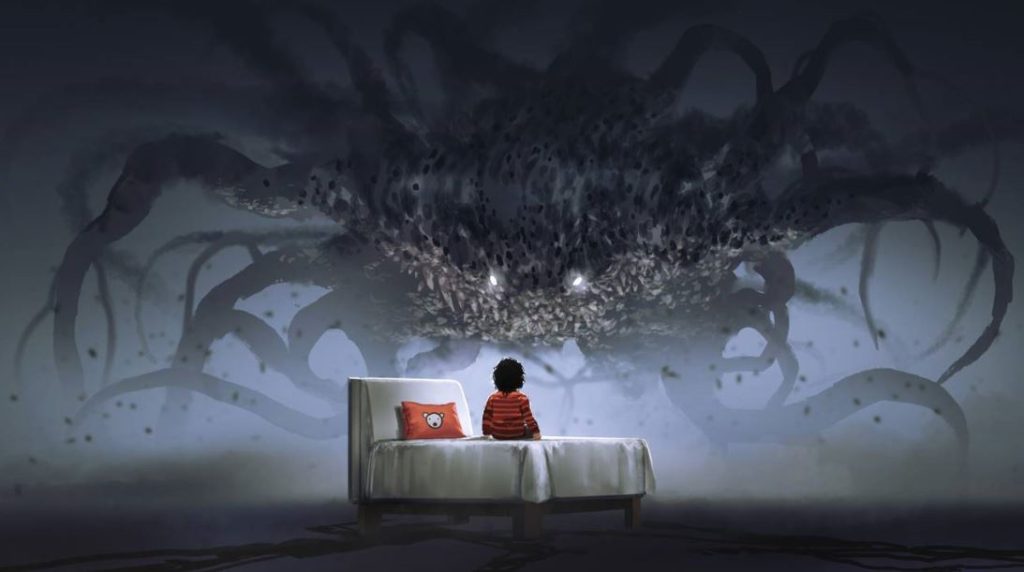
In my dream classes, I am always amazed at how well people recall their first childhood nightmares. They describe the dark woods or multi-limbed monsters as if the dream just happened yesterday. When we are very young, our dreams are more vivid, more memorable and often more frightening. Why is this? And what can we, as therapists or parents, do to help?
It’s well documented that children have more frequent nightmares. About half of children between the ages of 3 and 6 experiencing troubling dreams (Simard et al., 2008) and 20-30% continue to have frequent nightmares from age 6-12 (Nielsen et al, 2000). Typically, nightmares start to decrease naturally at about age 10 as children develop better emotional regulation strategies, and firmer boundaries between fantasy and reality.
Why do children experience more nightmares?
Very young children are still in the process of learning how to regulate emotion, and their developing nervous systems are more susceptible to alarm that flows into their dreams. Such dreams can be seen as the body’s way to helping to process all the new, at times overwhelming, experiences of childhood. In addition, a child’s developing brain spends more time in the dream-rich REM phase of sleep.
Children’s imaginations are boundless, the line between reality and fantasy still permeable, so their dreams tend to be more intense, vivid and experienced as very real. And although we might think of childhood as carefree, in fact, daily stresses loom large: a move, a fight with a friend, a shadow cast by a scary story can be huge, disturbing events for a child. Their nervous systems, less practiced in calming themselves, often pour these fears into dreams.
In short: Children’s brains are dream-rich, their lives are filled with novelty and stress, and they have fewer defenses against fear, making nightmares more frequent. Most children outgrow this as their coping skills, sense of safety, and nervous system regulation mature.
Differentiating nightmares and night terrors
While nightmares are common, they are not the only nighttime disturbance. Many parents know the fright of a child who suddenly sits up screaming, eyes open but unseeing. These are not nightmares but night terrors, a different sleep phenomenon altogether.
How do you tell the difference? Nightmares occur during REM sleep, usually in the second half of the night. The child wakes fully, remembers the dream vividly, and seeks comfort. Night terrors occur in deep non-REM sleep, often within the first few hours of bedtime. The child may scream, thrash, or appear terrified but is not truly awake. They rarely recall the episode the next morning.
This distinction matters. The soothing touch that helps a child wake from a nightmare can worsen a night terror, where arousal only prolongs the episode.
What Parents Can Do for Nightmares
Offer comfort and safety. Sit beside them, reassure them they are safe, and listen if they want to share. Avoid dismissing the dream as “just a dream” to the child, as the emotions and dream events themselves are real.
Normalize dreaming. Help them see that everyone dreams, and sometimes the mind uses dreams to work through fears.
Use creative rescripting. Invite the child to “rewrite” the dream in play or drawing. For example, they can become the hero of their dream and gain superpowers, like the ability to fly, disappear or befriend the monster. This is a child-friendly form of dream rescripting, an evidence-based approach to reducing nightmares (Krakow et al., 2001).
Establish calming routines. Predictable bedtime rituals like a story, soft light, and/or lullabies signal safety to the nervous system.
Address daytime stress. Nightmares often reflect daytime worries. Open space for the child to talk about school, friends, or family changes.
What Parents Can Do for Night Terrors
Do not try to wake the child. They are in deep sleep, and efforts to shake them awake usually increase confusion and agitation.
Keep them safe. Gently guide them back down if they sit up or try to get out of bed. Remove obstacles that could cause harm.
Wait it out. Night terrors usually pass within minutes. In the morning, the child will have no memory and needs no detailed explanation—only reassurance.
Promote good sleep hygiene. Overtiredness and irregular schedules increase night terrors. A consistent sleep routine often reduces their frequency (Petit et al., 2007).
When to Seek Extra Support
Most childhood nightmares and terrors fade with age. But if they are frequent, severe, or linked with trauma, extra care is needed. Therapists can use gentle, imaginative interventions like dream rescripting, sand tray, or focusing-oriented approaches to help the child work with the emotional material. Parents can collaborate with teachers, pediatricians, or counselors to reduce sources of stress and strengthen the child’s sense of security. If nightmares are trauma-related, specialized trauma therapies may be helpful.
Final Thoughts
Children’s nights are fertile ground for both wonder and worry. Dreams may bring them dragons, but also the courage and resourcefulness to tame them. With patience, creativity, and reassurance, parents and therapists alike can help children learn that the monsters in the night are not undefeatable, and that the world of dreams, even at its darkest, can be met with compassion and courage.
References
Krakow, B., Kellner, R., Neidhardt, J., Pathak, D., & Lambert, L. (2001). Imagery rehearsal treatment for chronic nightmares. Behavior Research and Therapy, 39(8), 843–856.
Nielsen, T., Zadra, A., Simard, V., Saucier, S., Stenstrom, P., Smith, C., & Kuiken, D. (2000). The typical dreams of Canadian university students. Dreaming, 10(4), 148–156.
Petit, D., Pennestri, M. H., Paquet, J., Desautels, A., Zadra, A., Vitaro, F., … & Montplaisir, J. (2007). Childhood sleepwalking and sleep terrors: A longitudinal study of prevalence and familial aggregation. Journal of the American Medical Association, 297(24), 2647–2654. https://doi.org/10.1001/jama.297.24.2647
Simard, V., Nielsen, T., Tremblay, R. E., Boivin, M., & Montplaisir, J. (2008). Longitudinal study of bad dreams in preschool-aged children: Prevalence, demographic correlates, risk and protective factors. Sleep, 31(1), 62–70. https://doi.org/10.1093/sleep/31.1.62